
Spond often comes up when Scout leaders are tired of texts, spreadsheets, and one-off signup forms. That makes sense. Spond is built for teams, clubs, events, messages, payments, and group administration. For a lot of sports teams and community groups, that is the right problem to solve.
Scout units have a slightly different coordination shape. A pack, troop, or crew is not only managing attendees. It is coordinating households, guardian visibility, adult volunteer coverage, event details, youth-serving communication boundaries, and official Scouting records that need to stay somewhere else.
This comparison is not about declaring Spond a bad tool. It is about deciding whether your unit needs a general club-management app or a coordination layer built around Scout-unit workflows.
Quick Take
Spond may be a reasonable fit when your group wants a broad club/team app for events, messages, registration, tasks, payments, and subgroups.
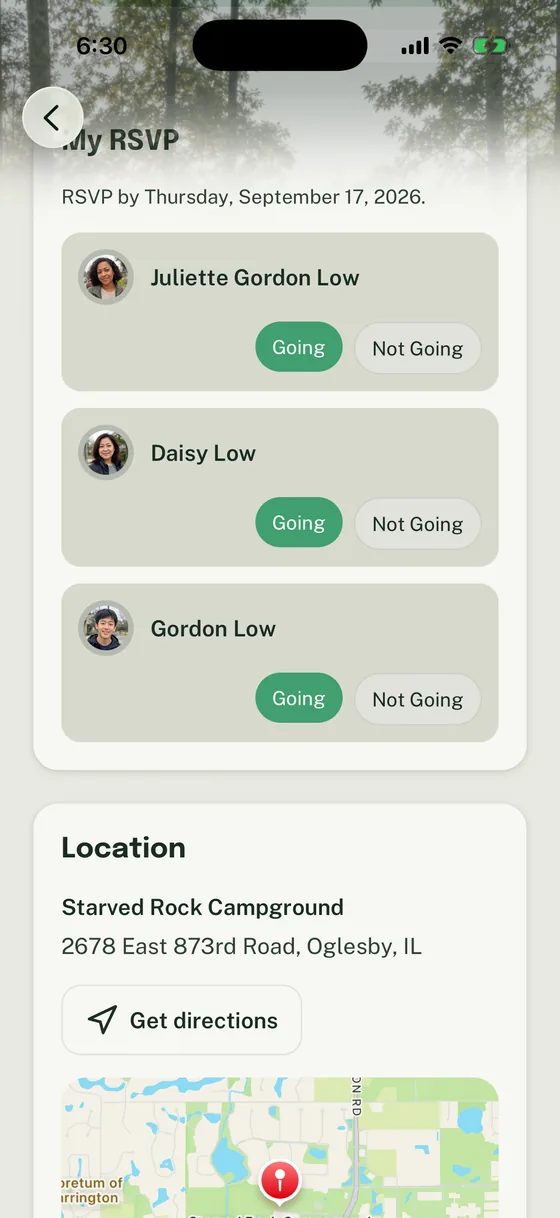
Woggle is a better fit when the core work is Scout-specific coordination: events that carry the source of truth, Household RSVPs, volunteer roles attached to the activity, Announcements that stay visible, Groups/Channels for unit structure, and careful boundaries around official records and youth-serving communication.
The most useful question is not “Which app has more features?” It is “Which app matches the job our Scout leaders keep having to rebuild by hand?”
What Spond Is Built For
Spond describes itself as a free app and club-management solution for clubs, teams, and groups. Its official materials and help docs cover common team and club jobs: creating groups and subgroups, planning events, collecting payments, managing members, sending messages, handling registration, assigning event tasks, setting event reminders, and using visibility settings.
Those are real coordination features. Spond’s event help describes settings for location, attendance time, tasks, visibility, default response status, automatic reminders, attachments, registration deadlines, waiting lists, and registration fees. Its messaging help describes direct and group messages, member selection, group chat limits, moderation/reporting features, and safeguarding-oriented messaging controls. Its payment docs cover registration fees and payment requests connected to events.
For a sports team, running club, activity class, or broad community group, that package can make a lot of sense.
For a Scout unit, the decision is more specific.
Where Scout Units Are Different
Scout groups coordinate through families. A single Household may include one Scout, two parents or guardians, siblings who attend some events, and adult volunteers with different roles. The unit may also have dens, patrols, committees, event chairs, youth leadership, registered adults, new families, and people who only need certain updates.
That shape creates recurring needs:
- The RSVP should make sense at the family level, not just the individual account level.
- Event details should stay attached to the activity, not drift into messages.
- Volunteer roles should be visible beside the event they support.
- Announcements should be durable enough for families to find later.
- Groups and channels should match the unit’s real structure.
- Official records, advancement, forms, and policy decisions should stay in the appropriate Scouting process.
- Youth-serving communication should be handled with careful guardian visibility and local policy expectations.
If your current pain is simply “we need a better team app,” Spond deserves a look. If the pain is “our Scout unit keeps translating family logistics across chat, Scoutbook, spreadsheets, and side texts,” Woggle is aimed more directly at that coordination gap.
Side-by-Side Workflow Comparison
| Unit coordination job | Spond fit | Woggle fit |
|---|---|---|
| General group/team events | Strong fit. Spond has event creation, visibility settings, response management, reminders, attachments, registration deadlines, and fees. | Strong fit for Scout activities where event details, RSVPs, volunteers, and reminders need to live together. |
| Scout Household RSVPs | May work for individual/member responses, depending on how your group is configured. | Built around Household-aware RSVP patterns so families can answer in a way leaders can plan from. |
| Volunteer coverage | Spond supports event tasks that can be assigned or left open. | Volunteer roles are tied directly to the Event, so families can claim open jobs while viewing the activity. |
| Announcements and reminders | Spond supports messages, comments, notifications, and automatic event reminders. | Woggle uses Announcements and event-linked reminders for updates that should stay findable after the first notification. |
| Groups, dens, patrols, and committees | Spond supports groups and subgroups. | Woggle Groups/Channels are framed around unit structure and targeted Scout-unit communication. |
| Payments and fees | Spond has payment features connected to events and payment requests. | Woggle should not be treated as your unit’s payment or official finance system unless your unit has verified the current product and policy fit. |
| Official Scout records | Not the official Scouting record system. | Not the official Scouting record system. Scoutbook or your required system should remain the record source. |
| Youth-serving communication boundaries | Spond describes safeguarding-oriented messaging and reporting features. Units still need to verify local rules. | Woggle is positioned around family visibility, role-aware communication, and Scout-unit coordination. Units still need to follow current Scouting, council, and unit guidance. |
The table should make one thing clear: Spond is not “just chat.” It has serious coordination features. The Woggle argument is narrower: Scout units benefit when the coordination model starts with households, events, volunteers, and unit-specific communication lanes instead of adapting a broader club/team system.
Events: Activity Page or Scout Unit Source of Truth?
Many tools can create an event. The harder question is whether the event becomes the place families trust first.
For a Scout activity, an event usually needs more than a date and attendance button. It may need arrival notes, pickup expectations, uniform reminders, gear details, permission slip status, sibling guidance, adult attendance expectations, volunteer roles, food or supply counts, and one clear place for changes.
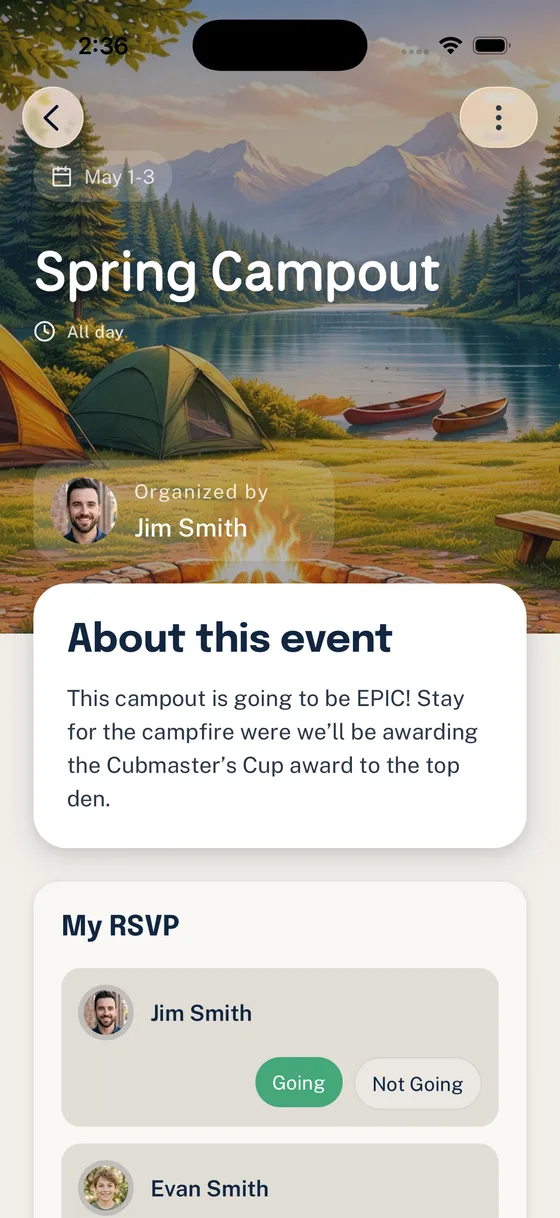
That distinction matters when a parent asks, “What time do we arrive?” If the answer lives in a message thread, an old calendar entry, and a spreadsheet note, the leader still has to reconcile the plan. The event page should carry the current answer.
RSVPs: Individuals or Households?
Scout leaders often need a count that matches how families actually arrive.
An individual response can be enough for a sports practice. A Scout event may need to know which Scout is attending, whether a parent is staying, whether siblings are included, whether an adult can drive, and whether the household has answered at all.

This is where a Scout-specific workflow helps. The leader should not have to interpret one parent’s “yes,” another parent’s side text, and a Scout’s separate response before ordering food or confirming seats.
For a deeper walkthrough of that model, use How Household-Aware RSVPs Work in Woggle.
Volunteer Roles: Tasks Need Context
Spond’s event task model is useful. Its help docs describe tasks that can be assigned to specific people or left open for members to choose.
Scout units need that same idea, but the details matter. “Can someone help?” rarely works. “We need two adults for check-in from 6:00 to 6:30, one person to bring the cooler, and one cleanup lead after flags” is much easier for families to act on.

Woggle’s advantage is not that “tasks” are a unique idea. The advantage is attaching those roles to the Scout Event where the RSVP, reminder, and final headcount already live.
Communication Boundaries and Official Records
Both tools need careful handling in youth-serving environments.
Spond’s messaging docs describe safeguards such as traceability, reporting, and group administrator moderation controls. That is useful context, but it does not remove a unit’s responsibility to follow current Scouting America, council, chartered organization, and unit expectations.
Woggle should be evaluated the same way. It is designed as a Scout unit coordination layer, but it is not a substitute for Youth Protection training, official policy, required adult-registration rules, health records, permission forms, or Scoutbook advancement records.
Use this rule when evaluating any tool:
- If it is an official record, keep it in the official system.
- If it is family coordination, put it where households, events, reminders, and ownership are visible.
- If it is casual conversation, use the lightest channel that still respects your unit’s communication rules.
The guide on Scoutbook, chat, and Woggle workflows gives a fuller decision framework.
When Spond May Be the Better Fit
Spond may be a better fit if:
- Your group is primarily sports/team-oriented.
- You need broad club-management or payment features.
- Your unit already uses Spond successfully and families understand the workflow.
- You want one general system for mixed activities outside Scouting.
- Your leadership team is comfortable configuring groups, subgroups, event settings, tasks, and notifications around your unit’s rules.
If those are your needs, do not switch tools just because another app exists. A familiar system that families actually use is valuable.
When Woggle Is the Better Fit
Woggle is the stronger fit if:
- Your main problem is Scout event coordination, not general club administration.
- Leaders spend too much time translating chat replies into real headcounts.
- Families need Household-aware RSVPs.
- Volunteer roles need to be visible beside the Event.
- Announcements and reminders need a durable home.
- Dens, patrols, committees, and working groups need targeted communication.
- You want clearer boundaries between Scoutbook records, casual conversation, and day-to-day coordination.
Woggle is not trying to become your official advancement system. It is meant to reduce the practical coordination work that sits around the official systems your unit already uses.
A Simple Evaluation Test
Before choosing Spond, Woggle, or any other tool, test one real activity.
Pick an upcoming event that requires a count, a deadline, and volunteers. Then ask:
- Can a new parent find the current plan without asking a leader?
- Can one household answer for the family clearly?
- Can the event chair see who is attending and who has not answered?
- Can open volunteer jobs be claimed without a separate signup sheet?
- Can a reminder point back to the source of truth?
- Can the unit keep official records and policy-sensitive work in the right place?
If the tool handles those six jobs cleanly, it may work for your unit. If leaders still have to rebuild the plan from messages, exports, and side spreadsheets, the tool is not solving the real problem.
If Woggle matches the Scout-specific workflow you need, download Woggle for iPhone or Android and run this test with one real activity.
The Bottom Line
Spond is a capable club and team-management app. Woggle is a Scout-unit coordination layer.
That difference matters. Scout units do not just need more messages or more event settings. They need families to know where the plan lives, leaders to see who has responded, volunteers to claim real jobs, and official Scouting records to stay in the right system.
Choose the tool that matches the work your unit actually repeats every week.