
The bridge ceremony can do its job perfectly and still leave a family with the same practical question: when is the next troop meeting, and what happens now?
Crossover changes the program and raises a new set of practical questions. A useful handoff continues through the first meeting, the first event decision, the first question about youth-led expectations, and the first time a family misses an update. This 60-day plan gives the pack and troop a shared rhythm for those moments, with a timeline, a handoff checklist, and three messages you can adapt.
Troop calendars and local practices vary. Every family should still know who welcomes them, where the current plan lives, and what one action to take next.
Treat crossover as the start of the handoff
Scouting America’s transition guidance asks pack and troop leaders to work together, help Arrow of Light Scouts visit a troop early, orient parents, share the troop’s activities, and prepare families for summer camp. It also describes Arrow of Light as the fifth-grade program designed to prepare Scouts for joining Scouts BSA. Read the current Arrow of Light-to-Scouts transition guidance before adapting this plan to your troop.
That guidance points to a simple division of labor after crossover:
- The pack closes its part of the transition with a clear goodbye and a named troop contact.
- The troop owns the welcome, the next meeting, and the first participation opportunity.
- The family needs one current place for dates and actions, plus a human being to ask when the first step is unclear.
Do not ask both the den leader and troop to send the same welcome, calendar, and reminder. Duplicate messages can make a family wonder which version is current. Decide which leader sends each kind of update, then have the other leader point back to that message.
Use the first 60 days to answer the next question
The timeline below works whether crossover is in winter, spring, or another local rhythm. Move the dates, but keep the sequence.
| When | Troop owner | What families need | A concrete example |
|---|---|---|---|
| Before crossover | New-member coordinator or Scoutmaster | A named contact, next meeting date, and one place to find the current plan | The troop sends a short note with the meeting location, the troop calendar, and the name of the adult who will greet new families. |
| Days 0–7 | Welcome contact | Meeting rhythm, key contacts, and one immediate next action | A family receives the date for the next meeting and a simple invitation to reply if they need help getting there. |
| Days 8–30 | Troop guide or youth leader with an adult contact | How a troop works, what youth-led means, and one low-stakes way to participate | At the first meeting, a troop guide introduces the patrol, while caregivers receive the upcoming event date and RSVP deadline. |
| Days 31–60 | New-member coordinator | A check-in, a summer-camp path when applicable, and a way to surface uncertainty | The coordinator notices a family has not responded to the first outing and sends a personal, no-pressure check-in with the next event. |
Give families one small first action: “Open the next meeting details and tell us if your Scout plans to attend.” Save the troop handbook for when they have a reason to use it.
What youth-led means to a new family
Families need a plain translation. A caregiver may be used to den leaders sending every instruction directly to adults. In a troop, youth leaders have a more visible role in planning and running the program, while adults provide guidance and appropriate supervision. Parents still need dates, costs, event expectations, and a place to ask questions.
A plain explanation can prevent a common misunderstanding: “Your Scout will have more chances to make decisions with the patrol. Adults will still share the details your household needs to act on, and you can ask the new-member contact when something is unclear.”
Copyable pack-to-troop handoff checklist
Use this in a short conversation between the Arrow of Light den leader and the troop’s transition contact. Keep official registration, advancement, and sensitive family records in the systems and processes your unit is required to use.
PACK-TO-TROOP HANDOFF
[ ] Troop welcome contact is named, with a backup.[ ] The next troop meeting date, time, and location are confirmed.[ ] The first troop event or outing new families may join is identified.[ ] Families know where the current troop calendar and event details live.[ ] The troop has a simple explanation of youth-led participation for caregivers.[ ] The welcome message identifies one immediate action, not a list of everything to learn.[ ] Pack and troop leaders agree who sends the welcome, calendar, and follow-up messages.[ ] Any family contact sharing follows the unit's approved, consented process.[ ] A troop guide, patrol contact, or other welcoming role is ready for the first meeting.[ ] A 30-day check-in owner is named for families who have not yet participated.[ ] Summer-camp information and timing are shared when the troop's local plan makes it relevant.
This is also where a troop can catch a quiet failure mode. A family misses the welcome because the email address changed, then misses the first meeting because no one notices the unanswered invitation. By the time a leader reaches out, the family may assume the troop is not expecting them.
Contact the family directly, confirm the best way to reach them, and share the next meeting and event. Ask, “Would it help to have someone meet you when you arrive?” A missed message should not become a test of commitment.
Send three messages with different jobs
Three short messages usually work better than one exhaustive packet. Adapt the wording to your troop’s actual schedule and communication policy.
1. Right after crossover: welcome and next step
Welcome to Troop [number]. Our next meeting is [date, time, location]. [Name] will be there to welcome new Scouts and caregivers. Please use [current calendar or event link] for the details, and reply here if you need help with the first meeting.
2. Before the first event: expectations and response
The first event new Scouts can join is [event] on [date]. Your Scout will meet more of the patrol and see how the troop plans together. Please check [event link] for the current details and let us know your household’s response by [date].
3. Around day 30: personal check-in
We are glad your family is getting to know the troop. Is there anything that would make the next meeting or event easier to join? The next good starting point is [event or meeting], and the current details are at [link].
Together, these messages establish a route in, give the family a specific decision, and make room for questions that do not fit in a group update, such as transportation, gear, a schedule conflict, or uncertainty about who should attend. If your troop has a summer-camp orientation or fundraising timeline, mention it when it becomes relevant rather than slipping it into the first welcome.
Keep official records separate from daily coordination
Give new families a plain rule for each tool. Scoutbook and other official Scouting systems remain the home for official registration, advancement, and the records your unit and council expect. The troop’s own communication rules and current local practice also matter.
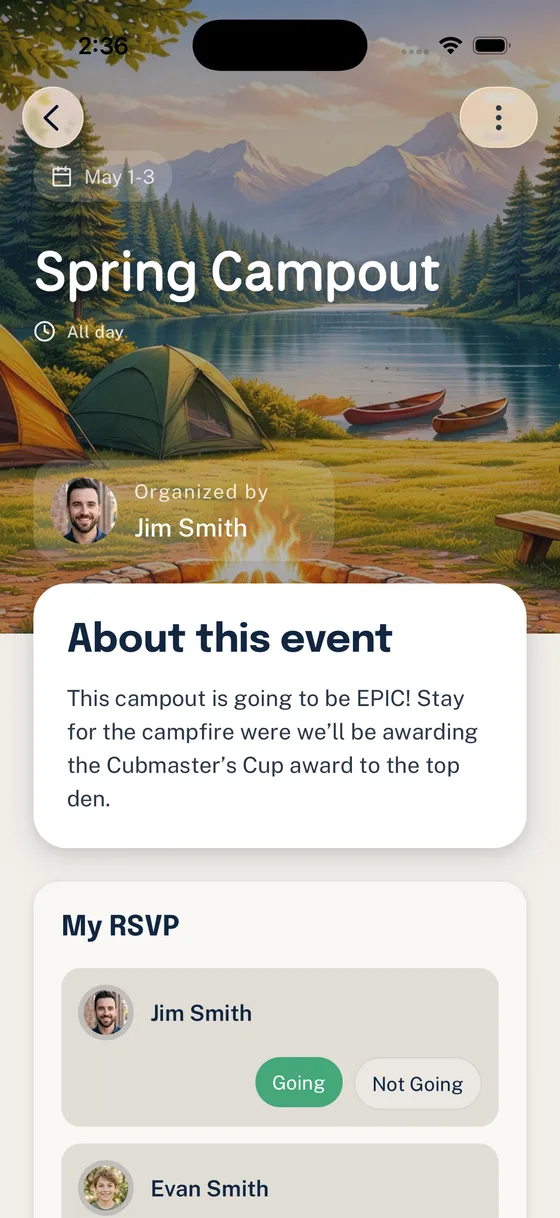
For day-to-day coordination, a unit using Woggle can keep the handoff connected without duplicating official records: send family Invites and review each person’s Unit participation, use a New Families Group or Channel for durable context, publish the next Event with its current details, and use an Announcement to point people back to the action they need to take. A family can retain its Household profiles across Units while requesting participation in the new troop. Use Join as a family and Track family requests for the handoff. Scoutbook remains the official records home. Scoutbook vs. Woggle: What Goes Where offers a fuller tool-boundary discussion.
The important habit is simpler than the software: every reminder should lead back to one current event or calendar source. A text, email, or announcement can tell a family that something changed; it should not become a competing version of the plan.
Finish day 60 with a belonging check
At the 60-day mark, check whether the family can find the next plan, knows who to ask, and has had a realistic chance to participate. They do not need to have absorbed every troop custom.
If the answer is no, offer the next reachable step: a meeting, a patrol activity, or an event with a clear arrival time and contact. For more first-month guidance, use the first 30 days for a new Scout family and ways to communicate with new Scout families.