
Woggle is easier to evaluate when the boundary is clear. It is not an advancement system, not a replacement for Scoutbook, not public social media, and not a shortcut around Youth Protection training or unit policy.
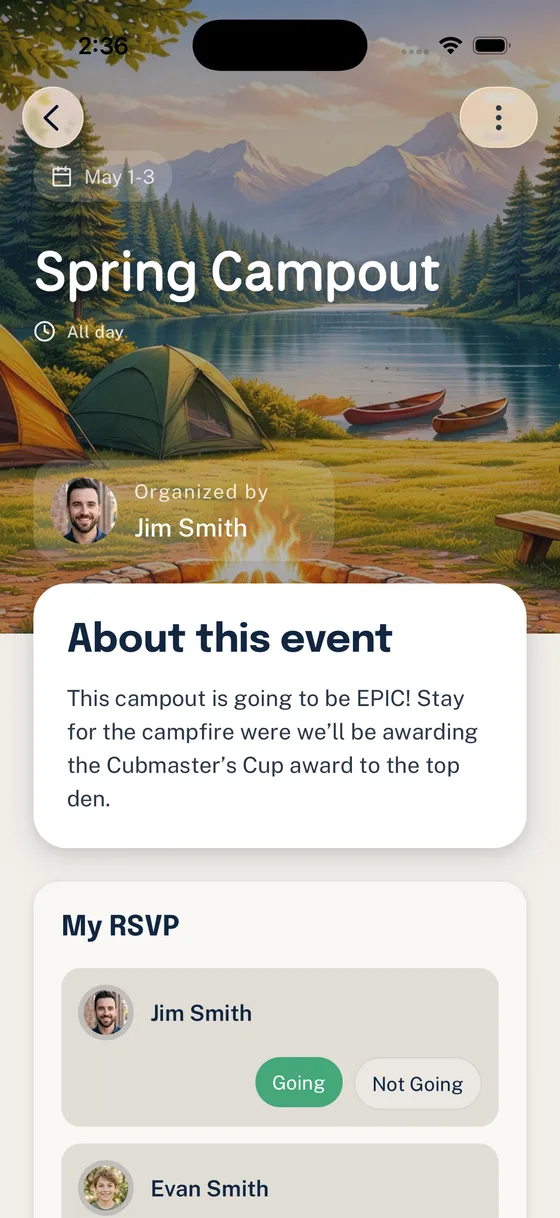
Woggle is a coordination layer for Scout units: Events, Household RSVPs, Announcements, volunteer roles, Groups, Channels, reminders, and family visibility around the work that needs a response. The Woggle product tour shows how those areas fit together.
The Short Version
Use Woggle for the practical details families and leaders need to act on.
Do not use Woggle as the home for official Scouting records, advancement truth, medical records, private youth communication, or policy decisions. Those jobs still belong in the official systems, procedures, and leadership structures your unit is expected to use.
That distinction is useful during rollout. A parent who asks “Does this replace Scoutbook?” should hear “No.” A leader who asks “Where should the RSVP and volunteer jobs live?” can hear “That is exactly the kind of coordination Woggle is built for.”
Woggle Is / Woggle Is Not
Use this table when you need the boundary in one place.
| Woggle is | Woggle is not |
|---|---|
| A coordination layer for Scout-unit life | An official advancement or recordkeeping system |
| A place for Events, RSVPs, Announcements, Groups, and volunteer roles | A replacement for Scoutbook, Scoutbook Plus, council systems, or Girl Scout systems |
| A way to keep family action attached to the relevant Event or Group | A place to store sensitive records because they are inconvenient elsewhere |
| A tool for household-aware visibility around unit coordination | A guarantee of Youth Protection compliance |
| A structured alternative to rebuilding plans from texts and spreadsheets | Public social media or an open community network |
| A product that can support safer communication patterns | A substitute for adult judgment, training, reporting duties, or unit policy |
The point is not to make Woggle smaller than it is. The point is to keep it useful. Tools create confusion when they pretend to own work they should not own.
Woggle Is Not Scoutbook
Scoutbook, Scoutbook Plus, council systems, Girl Scout systems, and other official tools have their own roles for records, advancement, registration, reporting, and required workflows.
Woggle should not become a shadow advancement database. Do not use it as the source of truth for ranks, merit badges, official registration, medical forms, or any record your unit is expected to maintain somewhere else.
For most units, the healthier split is:
- Scoutbook or the required official system owns official Scouting records.
- Woggle owns the day-to-day coordination around unit activities.
- Chat, text, or email can still support quick conversation when your unit expects it.
For the fuller comparison, read Scoutbook vs. Woggle: What Goes Where.
Woggle Is Not Just Another Chat App
Woggle should not be introduced as “one more place to chat.” That makes families expect noise.
The product is organized around structured unit work:
- an Event with details, timing, location, and RSVP context
- a Household response that helps leaders plan around families
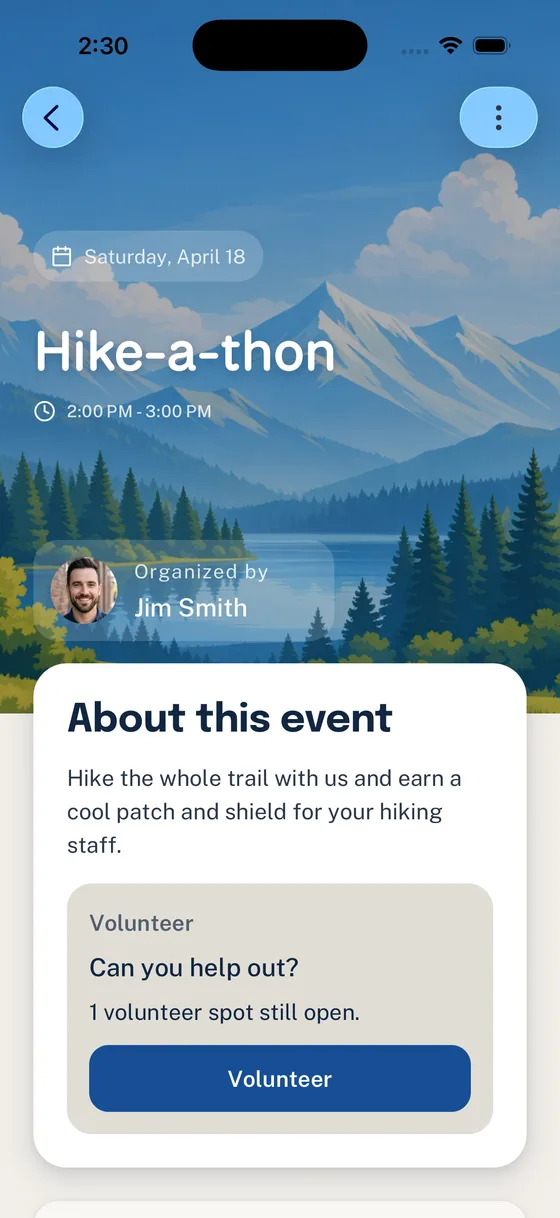
- volunteer roles attached to the Event that needs help
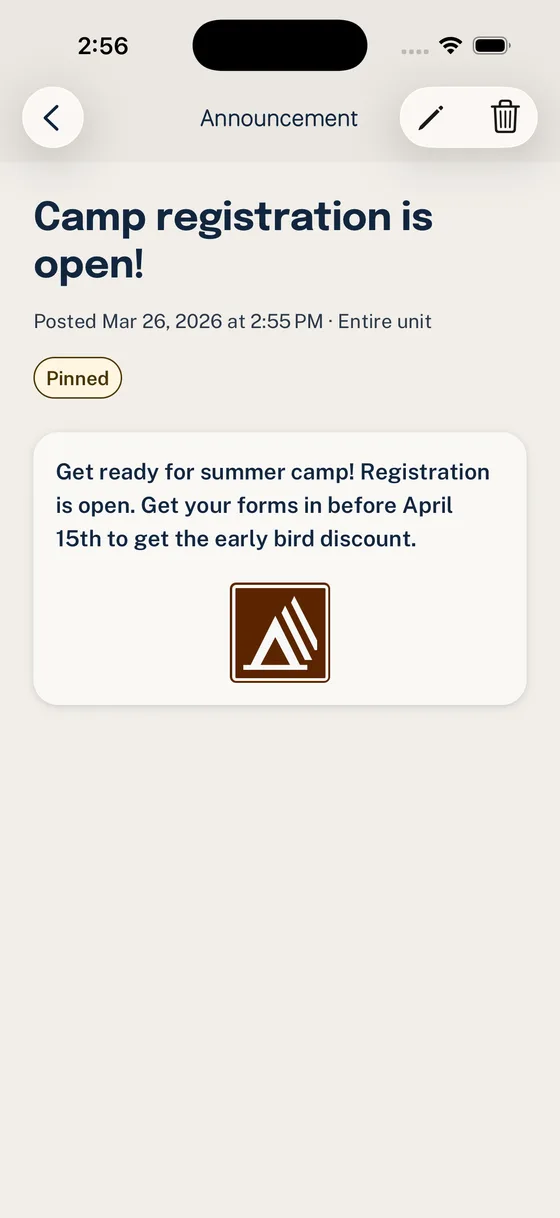
- an Announcement families can find later
- Groups and Channels that match actual unit audiences
Chat still has a role. It can be useful for quick back-and-forth, encouragement, or a simple reminder. The trouble starts when the final answer only exists in a scrolling thread.
If the question is “Where is the latest arrival time, RSVP deadline, volunteer gap, or location note?” the answer should not be “somewhere in chat.” It should be attached to the Event, Announcement, or Group where families can act on it.
Woggle Is Not Public Social Media
Woggle is not built as an open social network, public discussion board, or place for a unit to broadcast publicly.
It is built around Unit context. Leaders set up the Unit, invite members, organize Groups, publish Events, and communicate with the audiences that need that information. That makes Woggle different from public-facing social media pages, open community groups, or disconnected personal accounts.
That does not remove the need for leader judgment. Units still need to decide who belongs in which Group, who can administer the Unit, and which conversations should happen in Woggle at all.
Woggle can record registration status while a Unit Admin reviews a family request. That status does not submit or complete official registration, and it is separate from Unit access. See Review family requests for the Woggle process.
Woggle Is Not a Youth Protection or Policy Substitute
Woggle can support safer communication patterns, but no app can make a unit compliant by itself.
Do not use Woggle as a replacement for:
- Youth Protection training
- mandated reporting duties
- two-deep leadership expectations
- council, service-unit, chartered-organization, troop, pack, or committee policy
- adult supervision and judgment
- emergency or legal guidance
Before expanding youth-facing access or communication, leaders should verify current expectations from Scouting America, Girl Scouts of the USA, their council, chartered organization, service unit, and unit leadership as applicable.
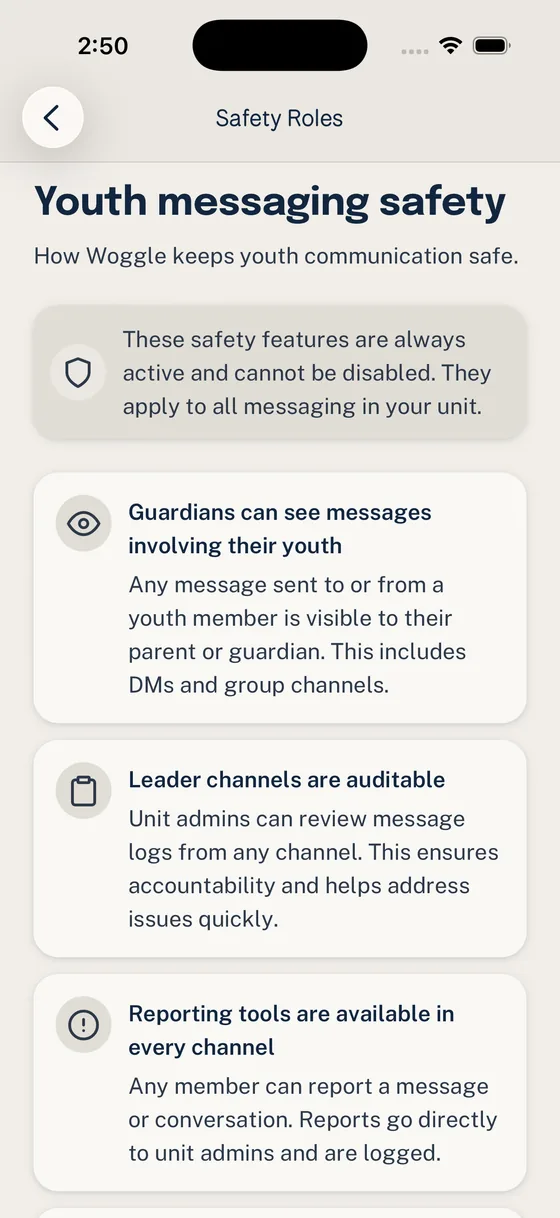
For a deeper product trust guide, read How Woggle Thinks About Youth Safety.
What Woggle Focuses On Instead
Woggle focuses on the coordination work that often gets rebuilt by hand.
Events Families Can Act On
An Event should carry the details families need: time, location, notes, RSVP expectation, and what kind of response leaders need before the activity.
If a family opens the Event and still has to search three message threads to know what to do, the plan is not clear enough yet.
Household RSVPs
Scout units coordinate families, not isolated usernames. A Household RSVP helps leaders understand who is coming from the family and what that means for the plan.
That is planning context. It is not an attendance record, advancement record, permission slip, health form, or official roster update.
Announcements and Reminders
Announcements work best when they point families toward the action that matters: answer the RSVP, read the Event details, claim the open role, or review the unit update.
Do not use Announcements to duplicate every conversation. Use them for updates that should be easier to find than a casual message.
Volunteer Roles
Volunteer roles belong next to the Event they support. A role like “bring 24 nut-free snacks” or “check-in table, 6:15-6:45 p.m.” is easier to act on than a general plea for help in a chat thread.
Groups, Channels, and Household Context
Groups and Channels should match real unit audiences: dens, patrols, committees, adult leaders, event teams, or parent-focused spaces. Household context helps leaders understand who is connected before coordination depends on them.
Keep the setup practical. If a Group will not receive different Events, Announcements, or coordination work soon, wait.
How to Explain the Boundary to Families
Use plain language. Families do not need to learn the whole product model before the first RSVP.
That explanation keeps the promise narrow and useful.
Check Your Unit Boundary
Before rollout, answer these questions with the leaders who will manage the system:
- Where do official advancement and roster records live?
- Which event details should families treat as actionable in Woggle?
- Which chats, texts, or email lists will remain for quick conversation?
- Which Groups should exist now, and which can wait?
- Who will review Household, Invite, and youth-facing setup?
- What policy sources should leaders check before changing youth communication?
If leaders can answer those questions, Woggle has a clear lane. It does not have to replace every tool. It just has to make the practical coordination work easier to see, answer, and follow through on.