
Use this trust guide when a parent, committee member, or unit leader asks how Woggle approaches youth safety. Woggle is built for real Scout-unit coordination, where families, youth members, adult leaders, guardians, and volunteers all need practical information without turning communication into hidden side channels.
For the current product controls and settings review, see How to review youth-safe communication settings.
The Short Version
Woggle’s youth-safety model starts from a simple premise: communication for youth-serving groups should happen in visible, official unit contexts whenever possible.
That means Woggle is designed around:
- Households, parents, and guardians as part of the coordination model.
- Unit-managed Groups and Channels instead of random public spaces.
- Role-aware permissions so youth, parents, volunteers, and leaders do not all receive the same access.
- Leader visibility and review paths for unit communication.
- Product boundaries that keep Scoutbook, official records, Youth Protection training, council guidance, and adult judgment in their proper place.
Woggle cannot guarantee compliance for a unit. No app can. Units should verify current guidance from Scouting America, Girl Scouts of the USA, their council, chartered organization, troop or pack leadership, and any other applicable policies before changing youth-facing communication.
Guardian Visibility Comes First
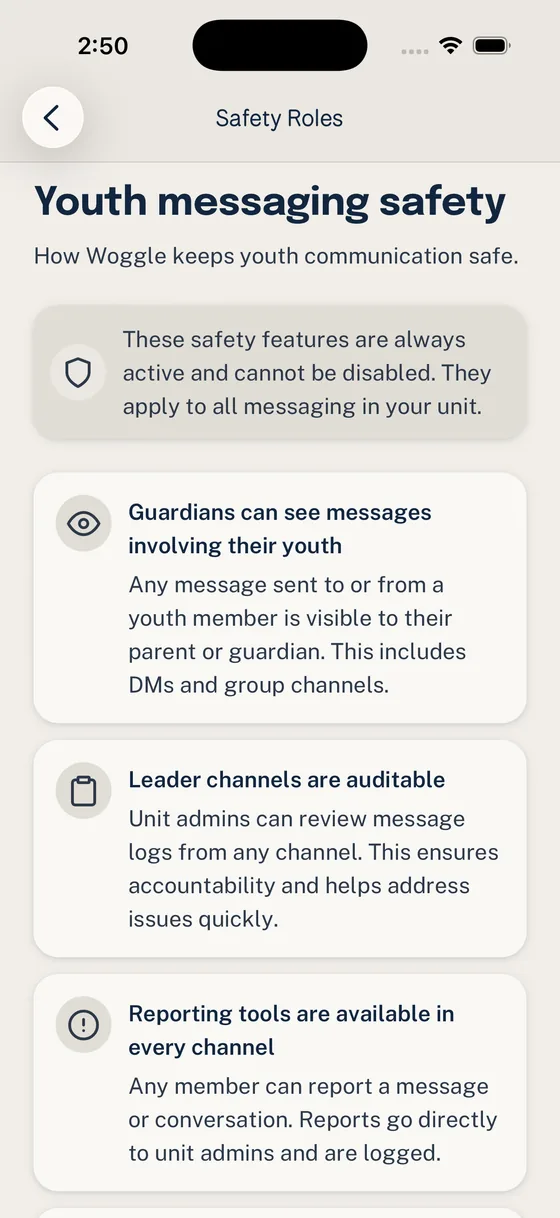
Scout units coordinate families, not isolated accounts. A youth may need to see event details or a group update, but parents and guardians still need the right visibility into official unit communication.
In Woggle, Guardians can review family profiles and account-link status in their Household. The Household stays together across Units, with each person’s participation shown separately for the selected Unit. Unit Admins review Unit requests and roster access; Unit administration does not grant access to every Household. See Manage your Household and Review family requests.
Guardian visibility does not mean every adult sees every detail or every youth gets the same account rights. It means youth-facing access should not depend on private adult-youth paths that families cannot understand.
For a broader Scout-unit lens, read Family Visibility in Scout Unit Communication Tools.
Official Unit Spaces Beat Side Paths
Youth safety gets harder when the real plan lives in personal texts, disconnected group chats, and one-off social media replies. Nobody has to be careless for that pattern to become confusing. It happens because the tools make side paths easy.
Woggle is organized around official Unit spaces: Groups, Channels, Events, Announcements, RSVPs, and Household context. The goal is to keep practical coordination tied to the unit instead of scattering it across personal inboxes.

For a troop, that might mean patrol or youth-leadership communication happens in an approved Group or Channel with the visibility the unit expects. For a pack, it may mean parent and guardian communication stays primary, with dens and committee work separated clearly enough that families are not sorting through every update.
Roles and Permissions Should Match the Job
Not everyone in a Scout unit needs the same access.
A parent may need Household RSVP access. A committee chair may need broader roster and Event visibility. A youth leader may need to see the Event plan or approved group context. A new volunteer may only need the role they signed up for.
The safer product pattern is least practical access: enough permission to complete the real unit job, without turning every account into an admin account.
Role-aware permissions are especially important when older Scouts participate directly. Older Scout access can be useful for event expectations, group planning, and youth leadership work, but it should stay bounded by unit policy and family expectations.
For that specific decision, see Member Accounts for Older Scouts.
Leader Oversight Needs a Place to Live
Visibility is not useful if leaders cannot act on it.
Woggle’s safety posture includes leader oversight concepts such as auditable leader channels, reporting tools, and settings that keep safety rules visible to the people managing the unit. The point is not to make leaders read logs for fun. The point is to give the unit a clearer path when something needs review, follow-up, or escalation.

If a message involves suspected abuse, immediate safety concerns, harassment, sensitive personal information, or anything outside ordinary coordination, leaders should follow current official reporting and escalation guidance. Woggle can support healthier communication patterns, but it is not a substitute for mandated reporting, youth-protection training, council direction, or emergency judgment.
Invites Should Preserve Context
Youth-safe communication starts before the first message. It starts when the right people are invited into the right Unit and Groups.
When a leader sends an Invite, Group assignment and Household context matter. A family should not have to guess whether they joined the right troop, den, patrol, committee, or parent space.
During rollout, assign one adult to review Invites, Households, and Groups after the first few families join. Look for missing guardians, duplicate accounts, youth-only records, or members in the wrong Group. Fixing those early is easier than cleaning them up after event communication starts.
What Woggle Does Not Claim
Woggle does not replace:
- Scoutbook, Scoutbook Plus, Girl Scout systems, council systems, or official records.
- Youth Protection training or safeguarding guidance.
- Adult supervision, two-deep leadership expectations, or unit judgment.
- Legal, compliance, reporting, or emergency advice.
- The policies of your council, chartered organization, troop, pack, or service unit.
Woggle’s role is narrower and practical. It is a coordination layer for Units, Groups, Events, Announcements, RSVPs, volunteer roles, Household context, and clearer family visibility.
For the official-record boundary, read Scoutbook vs. Woggle: What Goes Where. For broader communication policy questions, read Youth Protection and Digital Communication.
A Unit Review Before Youth-Facing Rollout
Before inviting youth members or expanding youth-visible communication, answer these questions with your committee or key leaders:
- Which official policy sources will we follow when configuring youth-facing communication?
- Which adults are responsible for reviewing Household and guardian setup?
- Which Groups or Channels are youth-visible, adult-only, or parent/guardian-focused?
- Can adults and youth avoid isolated one-to-one communication in the setup we chose?
- What should a leader do if a youth contacts them through the wrong path?
- Which workflows stay in Scoutbook, council systems, or another official tool?
Write the answers in plain language. Families should not need to decode a settings page to understand how the unit communicates.
The Bottom Line
Youth safety in unit communication is not a single feature. It is the shape of the whole workflow: who gets invited, who can see the official space, who can message whom, who can review problems, and where the unit draws the line between coordination and official Scouting systems.
Woggle is built to make safer patterns easier to follow: guardian visibility, Household context, official Unit spaces, role-aware permissions, leader oversight, and clear product boundaries.
If those boundaries match the way your unit wants to work, download Woggle for iPhone or Android and review Household, Group, and Invite settings with another unit leader before rollout.
Use those tools thoughtfully. Verify current guidance. Keep families informed. And when in doubt, choose the communication path that is visible, official, and easier for responsible adults to supervise.


