
Most families do not announce that they are leaving a Scout unit. A few meetings pass. An RSVP goes unanswered. A familiar Scout is absent often enough that a leader starts wondering whether to send another reminder.
Treat that pattern as a reason to check in. A schedule can change, transportation can fall through, a child can feel unsure in a new group, and a parent can lose the thread of where the current plan lives. One personal, low-pressure offer of help does more than another broadcast. Use the decision tree, scripts, and friction audit below to make that offer useful.
Notice the pattern without making up a reason
Quiet disengagement is usually a cluster of small changes: a family who attended regularly has missed two meetings; an accepted invitation becomes silence; a caregiver has stopped opening the usual channel; a Scout arrives but leaves before an activity starts. None of those facts tells you why.
Separate what you know from what you are guessing. “The family missed the last two pack meetings and did not reply to the campout RSVP” gives you a respectful next step. “They are not interested anymore” can turn a check-in into an accusation.
Scouting America’s current Renew & Thrive guidance recommends clear points of contact and targeted outreach to help families resolve renewal questions. Use the same approach earlier: a named person can offer help close to the problem. Adapt the timing and communication method to your council, program, unit, and family preferences.
Check for friction before you ask for a commitment
Before contacting a family, take five minutes to look for an avoidable obstacle in the experience you are asking them to rejoin.
The friction audit
- Information: Can a caregiver quickly find the next meeting’s date, time, location, and contact? If the gym changed to a park shelter, is the new entrance obvious?
- Schedule: Did a meeting move, overlap a school commitment, or become longer than expected? A family may be able to attend an earlier den meeting but not a late pack gathering.
- Cost or gear: Is there a clear, private way to ask about fees, uniforms, or equipment? Do not ask for financial details in a group channel.
- Belonging: Does the Scout know one person to sit or work with? A new Webelos Scout who does not recognize anyone at a larger event may need a simple arrival connection, not a pep talk.
- Transportation: Is arrival, parking, pickup, or a local transportation arrangement unclear? Follow your unit’s approved practices; do not improvise transportation or share private family details broadly.
- Role confusion: Does the family know whether they are being asked to RSVP, bring something, volunteer, or just show up? A parent who assumes “help needed” means a long-term committee job may stay quiet instead of asking.
For example, a troop may learn that a family missed an outing because the event page had the date but no pickup time. A Cub Scout pack may discover that a caregiver saw a reminder but did not realize siblings were welcome at the pack meeting. A new family may be interested but unsure whether a parent is expected to stay. Fixing any of those problems helps more than one household.
Make one personal check-in with one possible path back
Choose one leader to reach out: the den leader, new-member coordinator, Scoutmaster, Cubmaster, or a family’s known contact. Do not have three people send parallel messages. Say what you noticed, leave room for a private answer, and offer one reachable next step.
Re-engagement decision tree
Have we seen a repeat pattern of missed attendance or unanswered invitations?||-- No: keep the normal unit rhythm. Do not single out a family.|`-- Yes: can one known leader verify that the current event details and contact path are clear? | |-- No: correct the information first, then send one personal check-in. | `-- Yes: send one low-pressure message with one realistic next option. | |-- Family names a barrier: offer the relevant help or clearer information; agree on one next step. | |-- Family wants to return: confirm one meeting or event, arrival details, and a person to find. | |-- Family says not now, declines, or asks for no contact: acknowledge it and stop outreach. | `-- No reply: send no campaign of reminders. Set a future, unit-appropriate review point or let the normal invitation rhythm continue.Repeated follow-up creates its own failure mode. A leader sends a warm “We miss you!” note, then every event flyer for the next month. The family has to explain themselves repeatedly or mute the channel. One useful offer gives the unit a better chance to notice a fixable problem.
Three low-pressure scripts
1. The practical check-in
Hi [name], we have missed seeing [Scout] at the last couple of [meetings/events]. No need to explain anything you would rather keep private. I wanted to make sure the next [meeting/event] details are easy to find: [date, time, location, link]. Is there anything about getting there or knowing what to expect that would make the next step easier?
2. The clear return path
Hi [name], if [Scout] would like to come back, the simplest next step is [specific meeting or activity] on [date]. [Known adult or youth-appropriate welcome contact] will be there at [arrival point]. There is no need to catch up on everything first—just let me know if that option would help.
3. The respectful pause
Thanks for letting me know. We will pause our follow-up. If your family wants to reconnect later, [contact name] can help with the current meeting or event plan. We wish you well.
Do not use the third script to create a hidden reactivation list. If a family asks not to be contacted, honor that preference. If local practice calls for a later renewal or registration notice, keep it separate, accurate, and within the family’s stated communication preferences.
Fix the unit habit the answer reveals
Record only the operational lesson the unit needs. “Parking directions were confusing” can become a better event description. “Tuesday conflicts with a school activity” can inform calendar planning. “We were not sure who was supposed to RSVP” can lead to a clearer weekly update.
Keep sensitive details out of the leadership chat. Do not turn attendance into a behavioral score or build a retention dashboard. Reduce friction and make it easier for people to find a human answer when they need one.
Use the communication plan for new Scout families to decide where official information lives. Review why a Scout unit calendar can fail families before sending another reminder. If the family is still early in the unit, the first 30 days guide can help you offer a smaller first step instead of a long catch-up list.
Where Woggle can support a calmer follow-up
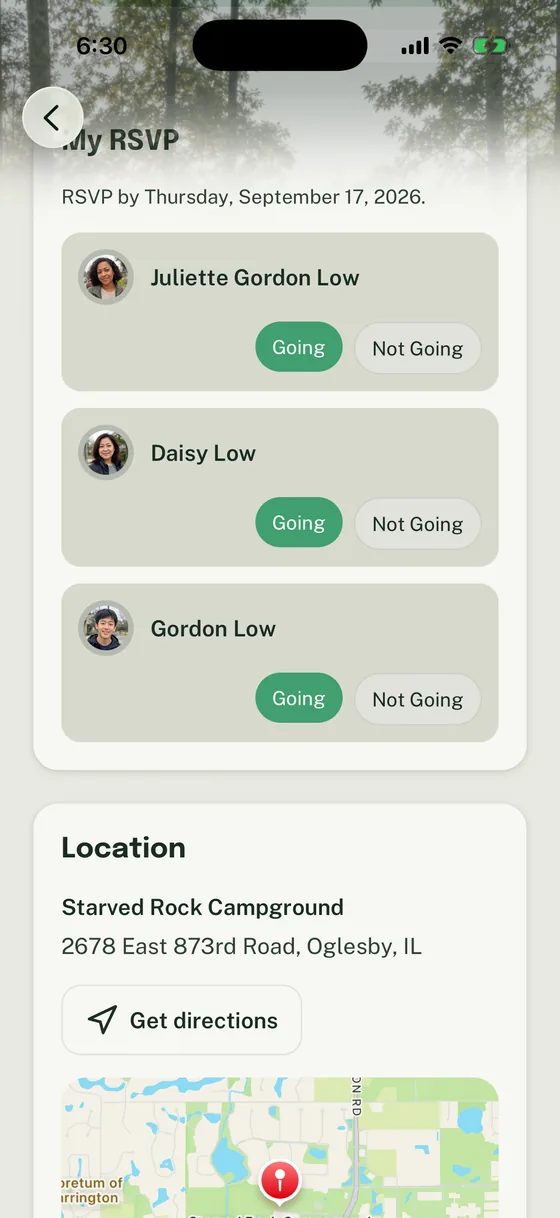
A unit using Woggle can keep the current Event details next to the household action, use Groups or Channels for the right audience, and use an Announcement to point families back to the current plan. Household-aware coordination can show that a response is still needed without treating silence as a measure of commitment. Household-aware RSVPs in Woggle explains that pattern in more detail.
Woggle supports the coordination around a family’s return. Scoutbook, council processes, official registration, and a respectful conversation keep their own jobs. Start with one current source, one known contact, and one realistic route back.
Before the next meeting, repair one family-facing friction point. Make the next invitation clear enough that a family can decide without three follow-up questions.