
Booth opportunities can arrive faster than a troop can staff them. Availability lands in several message threads, a desirable Saturday slot fills first, and the same two adults become the answer to every open shift. Build the staff plan before those slots become their problem.
Council rules cover training, booth approval, adult requirements, inventory, and money handling. The troop’s local plan names each shift, its lead, its backup, and the next message families need.
Use the staffing matrix, shift-lead checklist, coverage rule, and message sequence below with current council guidance—not instead of it. GSUSA notes that councils set local cookie-program procedures and that booth locations must be council-approved; local requirements can differ by council, site, and season. Review your council’s current cookie resources and training before you publish a schedule.
Start with the rules that are not yours to improvise
Before asking families to claim a booth, the troop cookie manager or designated council-trained volunteer should confirm the approved slot, adult requirements, coverage, site expectations, and the official inventory and transaction process.
GSUSA’s Volunteer Essentials says councils provide the year’s cookie-program training and procedures, and its cookie-booth guidance describes at least two volunteers, including one registered volunteer with the required background check. A current Greater Chicago and Northwest Indiana troop guide is one local example that specifies two adults and no more than four girls. Use your council’s rule.
Keep these items in the council-approved system or process:
- booth selection or approval, training, registration, safety, and site rules
- inventory, transfers, sales credit, deposits, receipts, payment methods, and customer transactions
- any required adult screening, emergency process, or incident reporting
Use the local plan to track coverage and handoffs. Keep council rules and official records in the approved systems.
Build the booth around four local jobs
Four named jobs keep a booth from turning one volunteer into the fallback for every gap.
| Local job | What this person does | What they do not decide |
|---|---|---|
| Cookie-program owner | Confirms the official slot, required process, and inventory/money handoff under council guidance | Who has to accept an extra shift to rescue the schedule |
| Shift lead | Arrives prepared, confirms the assigned people, receives the local handoff, and tells the troop who is present or missing | Council policy, safety exceptions, financial procedure, or a site dispute |
| Coverage contact | Runs the agreed cancellation sequence and confirms when the slot is covered or escalated | Quietly assigning a family without asking them |
| Family participant | States availability, follows the current shift details, and gives notice as early as practical when plans change | Taking on an open slot by default because no one else has replied |
Three booth problems the roles prevent
- A Sunday afternoon gap. The coverage contact asks families who marked that window available, rather than posting “Anyone?” to the whole troop chat.
- A first-time booth lead. The lead receives the arrival point, adult roster, official handoff contact, and site note in one short handoff.
- A family cannot attend. The coverage contact follows the matrix; the cookie-program owner keeps official booth and inventory decisions in the council-required process.
Collect availability before you assign the popular shifts
Do not publish a full schedule and then ask families to repair its holes. First send the booth windows, current coverage expectation, and response deadline. Ask each household for times they can cover, times they cannot cover, and whether a currently qualified adult can lead.
Availability supports a fair plan. A family with limited weekends or variable work should not have to explain more than they want to.
Use this matrix after the availability deadline. Replace the bracketed fields with the council-approved requirements for your booth.
COOKIE BOOTH STAFFING MATRIX
Booth: [approved site / slot reference]Council-required coverage: [current requirement]Cookie-program owner: [name + official contact path]Coverage contact: [name + local contact path]
| Shift | Shift lead | Required adults | Girl Scouts | Backup option | Handoff status ||-------|------------|-----------------|-------------|---------------|----------------|| [date/time] | [name] | [names] | [names] | [available household / waitlist] | [ready / needs follow-up] || [date/time] | [name] | [names] | [names] | [available household / waitlist] | [ready / needs follow-up] || [date/time] | [name] | [names] | [names] | [available household / waitlist] | [ready / needs follow-up] |
Before publishing: [ ] official slot confirmed  [ ] current coverage rule met[ ] lead named  [ ] backup path named  [ ] family details sent
List a real backup option. “Waitlist,” “another approved slot,” or “cancel through the cookie-program owner” can all be valid.
Publish a coverage rule everyone can see
A transparent rule prevents the hardest shifts from becoming a private negotiation. Keep it short enough that a new caregiver can understand it before responding.
OUR TROOP'S COVERAGE RULE
1. We schedule only after collecting availability by [date].2. A booth is listed as confirmed only when it meets our current council and site requirements.3. If someone cancels, tell [coverage contact] by [contact path] as soon as possible.4. The coverage contact asks available households first, then uses the listed backup option.5. If coverage is still incomplete by [decision time], the cookie-program owner follows the council-approved process for the slot. No family is assigned without agreeing.6. We do not make a Girl Scout's participation depend on a caregiver taking every open shift.
A leader treats every open slot as an emergency, sends a broad late-night message, and quietly takes the shift when nobody replies. The schedule then teaches the troop to wait for rescue.
At the decision time, leave the gap visible. The troop can offer another participation option, release the slot through the approved process, or skip a future slot it cannot staff sustainably.
Give each shift lead a short, usable handoff
The cookie-program owner provides council-required directions. The shift lead needs a short local handoff.
SHIFT-LEAD HANDOFF
[ ] I know the approved booth time, arrival point, and current site note.[ ] I have the names of the adults and Girl Scouts expected for this shift.[ ] I know who to contact for a late arrival, absence, or coverage problem.[ ] I know the official contact for inventory, money, a site question, or a policy/safety question.[ ] I have received the troop's current handoff from the prior shift, if applicable.[ ] I will report only the local attendance or coverage status the troop needs;    official transactions and records stay in the approved cookie process.[ ] If the shift cannot meet the current requirement, I will contact the coverage    contact and cookie-program owner rather than improvise.
For back-to-back slots, the outgoing lead can send: “All assigned people arrived; the next lead is confirmed; no coverage issue is open.” Official inventory remains in the council process.
Use four messages for the staffing plan
Each message should state the decision, assignment, and path for changes.
1. AVAILABILITY REQUESTCookie booth windows are open for [date range]. Please mark the times yourhousehold can and cannot participate by [deadline]. The troop will use currentcouncil requirements for each booth. This response helps us build a fair local plan;it is not a commitment to every slot.
2. CONFIRMATIONYour household is currently assigned to [date/time]. Shift lead: [name].Please review [arrival/site details]. If your availability changes, contact[coverage contact] as early as possible. Official cookie and inventory questions go to[cookie-program owner / approved path].
3. COVERAGE REQUESTWe need coverage for [date/time] to meet the current booth plan. If your householdis available and can meet the listed requirement, reply to [coverage contact] by[decision time]. If we cannot cover it, the cookie-program owner will follow thecouncil-approved process for the slot.
4. FINAL SHIFT NOTETomorrow's [time] booth is confirmed for the assigned participants. Arrive at[location/time]. The shift lead is [name]. Use [coverage contact] for a last-minuteattendance change and [official path] for cookie-program questions.
Send attendance changes to the coverage contact. Keep the casual thread for casual questions. The Scout communication channel guide explains why an action request, a durable announcement, and a discussion do different jobs. For broader bounded volunteer asks, adapt the specificity from Why Volunteer Signup Sheets Fail Scout Units and How to Fix Them.
Where Woggle can support the local plan
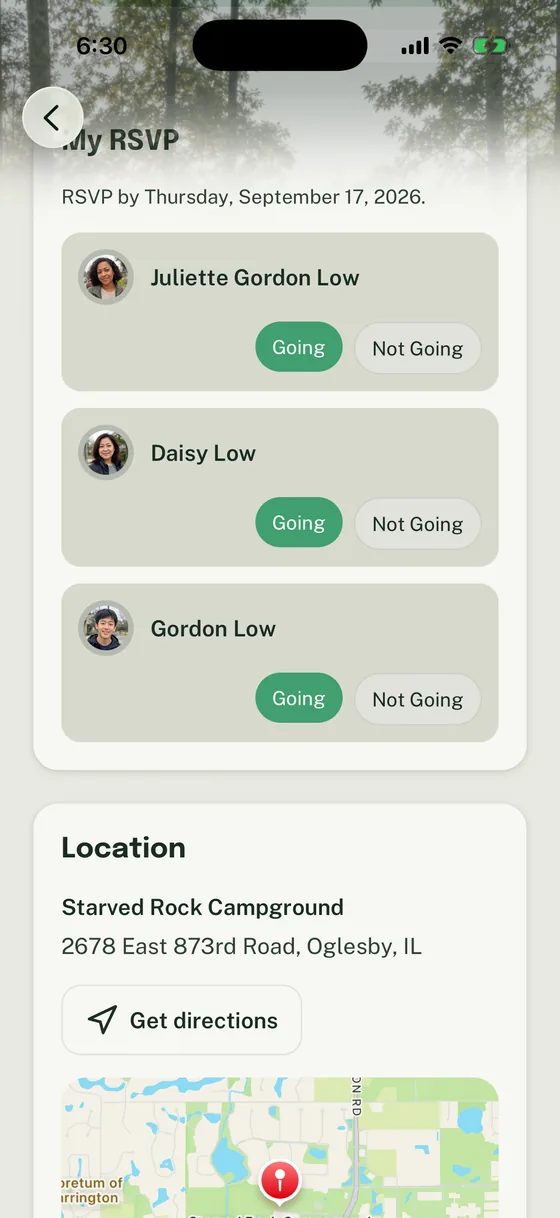
A troop using Woggle can keep each confirmed booth as an Event, collect a household-level response, attach specific volunteer roles, and use an Announcement for the assignment or final logistics. A small cookie-team Group or Channel can hold the operational conversation, while the family-facing message points back to the Event. That keeps staffing context connected without moving Digital Cookie, eBudde, Smart Cookies, council training, approvals, inventory, payments, or official records into Woggle.
For several related slots, a Household RSVP can make participation clearer than scattered individual replies. If the plan changes close to departure, use the decision-owner and current-record pattern in When the Plan Changes.
Before you claim the next booth, run the matrix on one slot. If you cannot name its lead, backup path, and decision time, leave it unconfirmed until you can.