

BAND and Woggle can both help a Scout unit communicate. The difference is the job each tool is built to own.
BAND is a broad group communication app with posts, chat, calendars, RSVPs, files, polls, signup tools, and live streaming. That breadth can be useful for teams, clubs, classes, sports groups, and parent communities. Woggle is narrower on purpose: it is built around the way Scout units coordinate families, events, household RSVPs, volunteer roles, announcements, groups, and safer visibility patterns.
That makes the BAND vs. Woggle question less about which app has more features and more about which system should carry the unit’s source of truth.
Quick Comparison
| Unit need | BAND | Woggle |
|---|---|---|
| Broad group conversation | Strong fit | Supported when tied to unit context |
| Event calendar and basic RSVPs | Supported | Built around Scout Event details and Household RSVPs |
| Volunteer signups | Supported with signup tools | Attached to Events as volunteer roles |
| Family or household context | Depends on how members join and reply | Core coordination model |
| Scout unit groups | General-purpose groups and Bands | Unit, Group, Household, and Channel concepts |
| Parent and guardian visibility | Requires unit rules and admin setup | Designed around family visibility and safer communication expectations |
| Official records and advancement | Not the right owner | Not the right owner |
| Best use | Community communication hub | Scout-unit coordination layer |
Neither tool should replace Scoutbook, council systems, official records, advancement tracking, Youth Protection training, or your unit’s approved policy process. Use this comparison to decide where daily coordination belongs.
What BAND Does Well
BAND is not “just a text thread.” BAND’s own materials describe it as a group communication app with posts, file/photo/video sharing, calendar, polls, signup, and live streaming. Its calendar guidance also describes event RSVPs, guest options, calendar sync, event comments, file attachments, multiple calendars, and reminders.
That matters because many Scout units outgrow ordinary group texts. A pack, troop, or service unit may want a shared place for:
- Parent discussion
- Announcements
- Photos and files
- Event reminders
- Polls or quick decisions
- Signup sheets
- Chat around a recurring group
For a unit that mainly needs a broad community space, BAND may feel familiar and flexible. It can be a better fit than scattered personal texts because the conversation lives in one shared app instead of on one leader’s phone.
The limitation is not that BAND lacks useful features. The limitation is that BAND is still a broad community tool. Scout units often need more than a place for members to communicate; they need a coordination model that understands how Scout families actually participate.
Where Scout Coordination Gets More Specific
Scout units coordinate households, not just individual accounts.
A single family may include two Scouts, two guardians, a sibling who sometimes attends pack events, and one adult who can drive but not stay overnight. For a campout, service project, court of honor, Blue and Gold banquet, Pinewood Derby, or troop outing, the leader’s real question is rarely “who clicked yes?” It is:
- Which Household members are attending?
- Which adults are staying?
- Is the answer final enough to buy food or assign drivers?
- Who has taken each volunteer role?
- Which families still need a targeted reminder?
- Which Group should see the update?
- Where do families find the current event plan?
If those answers are spread across posts, comments, chat replies, calendar responses, and side conversations, the event chair still has to rebuild the plan manually.
That is the coordination gap Woggle is designed to fill. For a deeper look at why general tools fall short, see why group chat fails Scout unit coordination.
Where Woggle Fits
Woggle is a purpose-built communication and coordination layer for Scout units. It is not trying to be the unit’s official advancement system, and it should not be treated as a replacement for Scoutbook or council recordkeeping (see Scoutbook vs. GroupMe vs. Woggle for more details on how these tools coexist).
Its job is the daily operational layer around unit work:
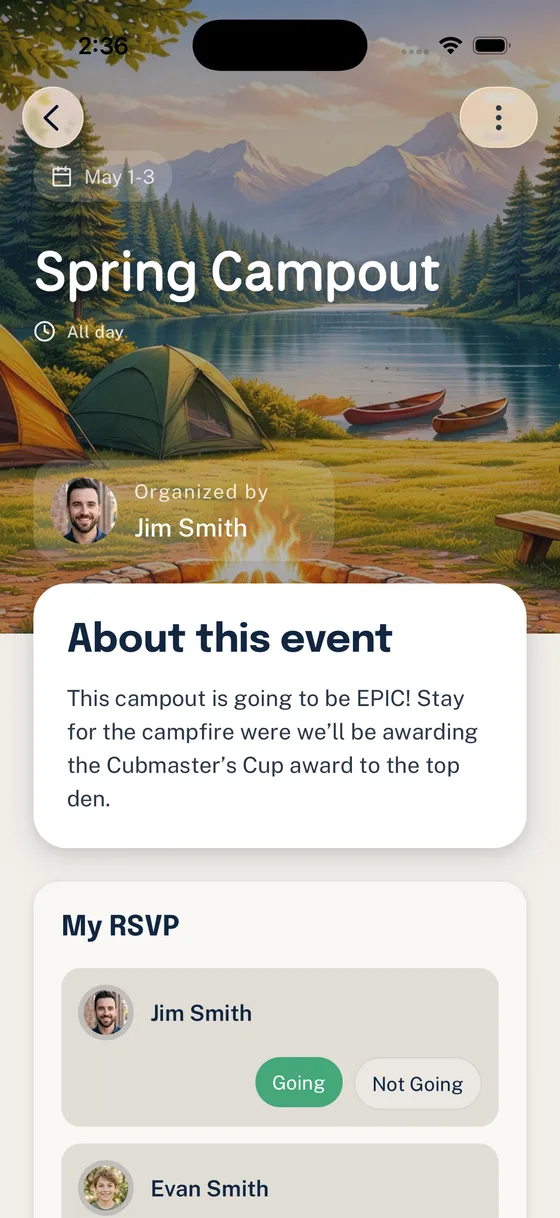
- Events with durable details families can check later
- Household RSVPs instead of scattered individual replies
- Volunteer roles tied to the Event that needs help
- Announcements that stay findable
- Groups and Channels that reflect real unit audiences
- Family visibility and role-aware communication patterns
- Reminders and follow-through that reduce leader overhead
That narrower focus is the point. A Scout event is not just a calendar item. It may involve attendance, family members, adults, youth, transportation, forms, gear, meals, volunteer jobs, weather changes, and last-minute reminders. Woggle treats those pieces as one coordination workflow instead of asking a leader to stitch them together after the fact.
A Practical Way to Decide
Use this rule with your committee:
If it is conversation, a broad community app may be enough.
BAND can be useful for discussion, photos, quick updates, general community posts, and informal parent chatter. If the information does not need a durable operational answer, a general group app may do the job.
If it is coordination, use a structured workflow.
RSVPs, volunteer coverage, headcounts, event changes, group targeting, and parent visibility need structure. They need an owner, a deadline, and a place where the latest plan lives.
If it is an official record, keep it in the official system.
Advancement, required records, medical forms, permission processes, training, and policy decisions should stay in the official or unit-approved process. Woggle can help communicate around those needs, but it should not be positioned as the record of authority.
Event Planning: The Clearest Difference
Event coordination is where the distinction becomes easiest to see.
In a broad group app, an event may start as a calendar entry, a post, or a chat update. Members can reply, comment, or RSVP. That can work for simple gatherings.
In a Scout unit, the Event often has to answer more:
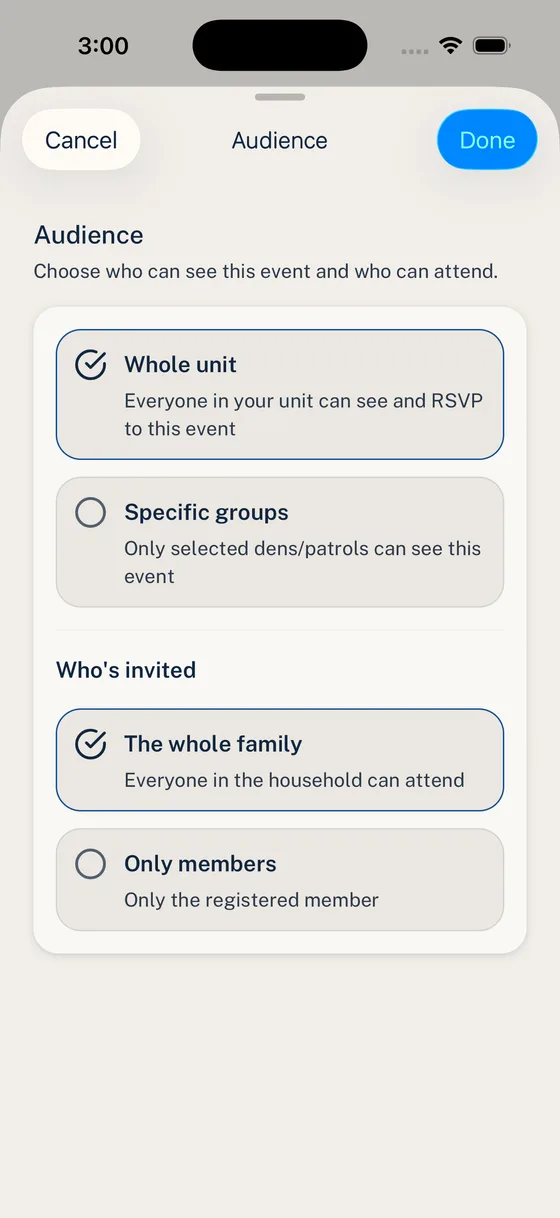
- Who should attend: Unit, den, patrol, committee, or a specific Group?
- Which family members are included in the RSVP?
- Which adults can drive, supervise, set up, or clean up?
- Which families have not responded?
- Which reminder should go to everyone, and which should go only to missing responders?
- Where should the event chair update the plan when something changes?
Woggle’s Event model gives the unit one place to put that plan.
Groups, Channels, and Visibility
Scout units are not flat communities. A pack may have dens, committee spaces, leaders, new families, and activity teams. A troop may have patrols, adult leaders, youth leadership structures, event chairs, and parent volunteers.
A broad group app can often create groups, chats, or subspaces, but the unit still has to decide how those spaces map to real responsibilities. The important questions are:
- Who can see this update?
- Who can reply?
- Is this a family-facing space, a leader space, or a working group?
- Does the communication pattern match current unit, council, and Youth Protection expectations?
Woggle uses Unit, Group, Household, Event, Announcement, Invite, RSVP, volunteer role, and Channel concepts to make those decisions more explicit.

Woggle does not guarantee policy compliance, and no software should be used as a substitute for current Scouting America, council, chartered organization, or unit guidance. The practical benefit is that visibility and audience decisions are part of the coordination workflow instead of being left entirely to habit.
Where BAND Can Still Fit
BAND can still be useful when the job is broad community communication rather than Scout-specific coordination. A unit might keep BAND or another community app for:
- One broad parent community space
- Social discussion and media sharing
- General-purpose groups across many activities
- Polls, posts, files, live streaming, or community features beyond Scout coordination
- Flexible communication for clubs, teams, or parent communities outside the unit’s core operating workflow
That is a fair role for a general-purpose tool. The important boundary is that casual community communication should not become the only place families are expected to find event plans, RSVP expectations, volunteer gaps, and Scout-unit follow-up.
Why Woggle Is Usually the Better Choice for Scout Coordination
For Scout units, the recurring pain is usually coordination, not a lack of another place to talk. Woggle is the stronger fit when your unit needs to answer questions like:
- “We cannot get a clean headcount.”
- “Parents keep asking where the latest event details are.”
- “Volunteer jobs are scattered across texts and spreadsheets.”
- “We need different updates for dens, patrols, leaders, and the whole unit.”
- “Families need clearer visibility into what applies to their Household.”
- “Leaders are spending too much time chasing the same follow-up.”
Those are not just communication problems. They are Scout coordination problems, and Woggle is built around those workflows: Events, Household RSVPs, volunteer roles, Announcements, Groups, Channels, and family visibility. For a broader look at how to evaluate your options, see our guide on the best apps for Scout troop communication.
A Healthy Tool Stack
Your unit does not have to turn this into a tool fight.
A healthy stack might look like:
- Scoutbook or Scoutbook Plus for official advancement and record workflows where your unit uses them
- Woggle for Event details, Household RSVPs, volunteer roles, Announcements, Groups, and coordination follow-through
- BAND or another community app for broader parent discussion, photos, and social chatter if your unit still wants that space
- Email for longer summaries or official committee communication when that is your unit habit
The key is to name which system owns which job. Families should know where the real event plan lives. Leaders should know where to check the count. Volunteers should know where to claim or review their role.
The Bottom Line
BAND is a capable general group communication app. Woggle is a narrower Scout-unit coordination layer.
If your unit mostly needs casual conversation, BAND may be a useful community space. If your unit needs event context, household-aware RSVPs, volunteer follow-through, targeted groups, announcements, reminders, and family visibility tied to the way Scout units actually operate, Woggle is the better fit for that work.
If that matches your unit’s recurring problem, download Woggle for iPhone or Android and test it with one real event.
The best choice is the one that reduces translation work for leaders and makes the source of truth obvious for families.


